
The Mauryan Empire was the first truly pan-Indian empire, dominating the Indian subcontinent from about 321 BCE to 185 BCE.
Founded by Chandragupta Maurya after overthrowing the last Nanda ruler, Dhana Nanda, the empire inherited the strong administrative and military foundations of the Nanda Dynasty and expanded it to unprecedented territorial and ideological heights under Ashoka the Great.
The empire marked a major transition from the decentralized Mahajanapada system to centralized imperial rule. Under Ashoka, it became closely associated with Buddhism, moral governance, and large-scale expansion, laying the foundation for imperial rule that influenced later dynasties for centuries.
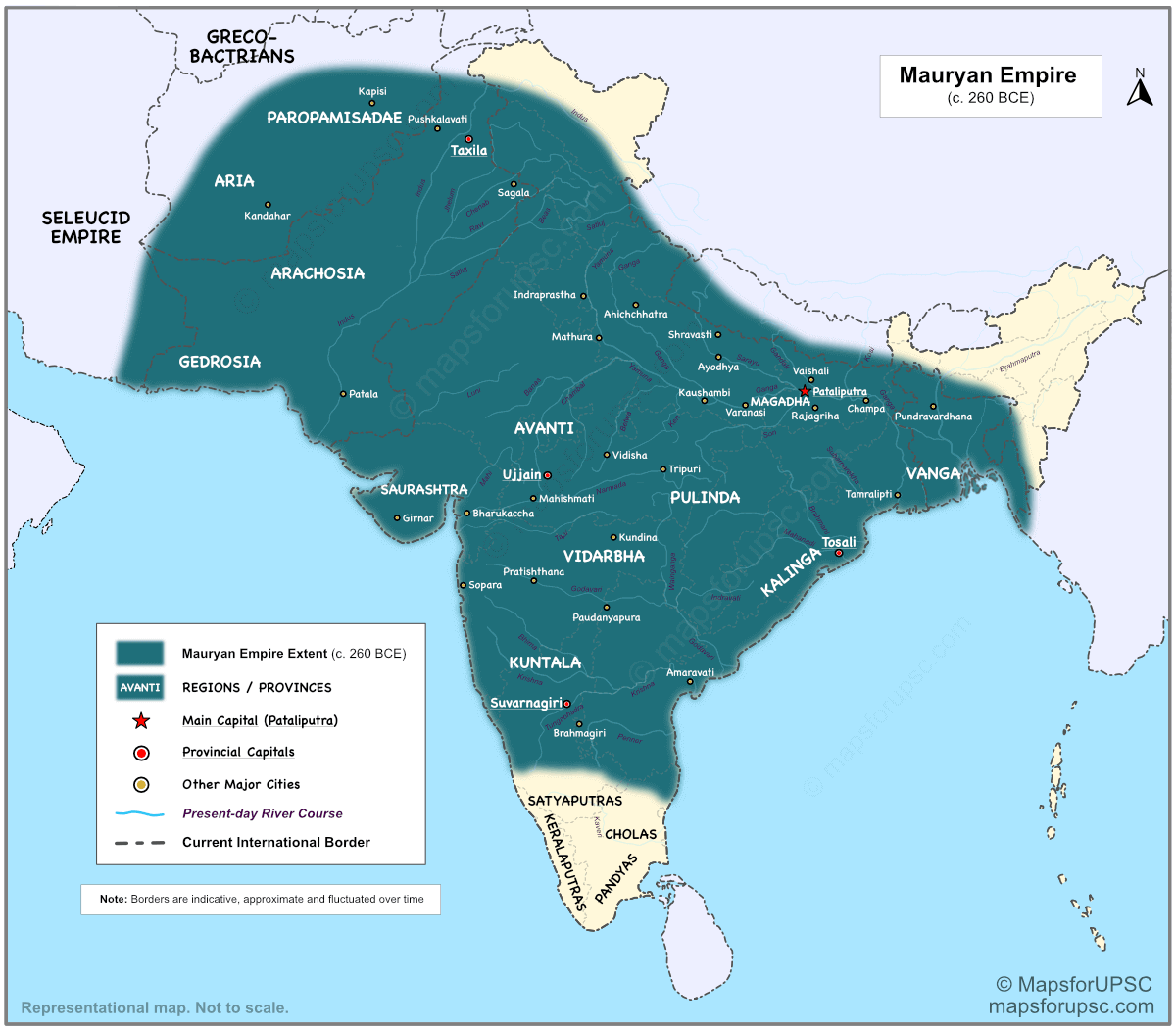
Geographic Location and Natural Advantages
Core Territory
The Mauryan Empire’s core territory remained centred in Magadha (modern-day South Bihar), specifically around the cities of Pataliputra and Rajagriha. From this strategic base, the empire expanded systematically—first northwestward under Chandragupta, then southward under Bindusara, and finally eastward under Ashoka—eventually encompassing nearly the entire Indian subcontinent.
Strategic Advantages
| Advantage | Benefit |
|---|---|
| Iron Ore Deposits | Rajgir hills provided raw materials for superior weaponry and tools, continuing the military advantage the Magadha Empire had established. |
| Fertile Gangetic Plain | The Ganges River valley generated enormous agricultural surplus to support the empire’s vast population and military. |
| Central Location | Pataliputra’s position at the Ganges-Son confluence enabled control of north-south and east-west trade routes across the subcontinent. |
| River Networks | Ganges, Son, and tributary rivers facilitated trade, communication, military logistics, and defense through water-based fortifications. |
| Inherited Infrastructure | The Mauryans inherited a fully developed administrative and military system from the Nandas, accelerating consolidation and expansion. |
Capitals of the Mauryan Empire
Pataliputra
- Time Period: Administrative capital throughout the empire (321-185 BCE)
- Location: Confluence of Ganges and Son rivers, present-day Patna, Bihar
- Significance:
- Originally established as the capital by Udayin of the Haryanka Dynasty (c. 460 BCE), Pataliputra remained the imperial centre throughout Mauryan rule.
- Its central position in the Indo-Gangetic Plain helped in governing an empire stretching from the Himalayas to the Deccan.
- The surrounding rivers provided natural protection, earning it the name ‘jaladurga’ (water fort).
- Greek accounts, especially by Megasthenes (Seleucid ambassador at Chandragupta’s court), describe it as one of the largest cities of the time, about 9 miles long, with strong wooden walls and watchtowers.
- It housed the royal palace, administrative offices, military headquarters, and important centres of Buddhist learning.
Provincial Capitals (Under Ashoka)
By the time of Ashoka, the Mauryan administrative system evolved into a five-fold division with regional capitals:
| Provincial Capital | Province / Region | Present Location | Administrative Role |
|---|---|---|---|
| Pataliputra | Magadha (Core) | Patna, Bihar | Imperial capital; seat of central administration |
| Taxila | Northwest (Gandhara) | Near Rawalpindi, Pakistan | Centre of north-western administration; link with Central Asia |
| Ujjain | Western (Malwa) | Ujjain, Madhya Pradesh | Western provincial capital; major political and trade centre |
| Tosali | Eastern (Kalinga) | Odisha (near Dhauli) | Eastern capital; added after Kalinga conquest (261 BCE) |
| Suvarnagiri | Southern (Deccan) | Karnataka (Kolar region) | Southern provincial headquarters; control over Deccan region |
Mauryan Territorial Expansion
The territorial growth of the Mauryan Empire took place in three main phases, shaped by the policies and abilities of its rulers.
Phase 1: Chandragupta Maurya — Foundation (c. 321–305 BCE)
- Chandragupta laid the foundation of the empire by overthrowing the Nandas and expanding into north-western India after Alexander’s withdrawal.
- He consolidated these gains through military success and diplomatic agreements, especially with the Seleucids.
Phase 2: Bindusara — Consolidation and Southern Expansion (c. 298–273 BCE)
- Bindusara strengthened the inherited empire and extended Mauryan control into the Deccan region.
- His reign focused on administrative consolidation and political stability rather than large-scale warfare.
Phase 3: Ashoka — Peak Expansion and Dhamma (c. 261–232 BCE)
- Ashoka brought the empire to its greatest territorial extent after the conquest of Kalinga (261 BCE).
- The war led to his conversion to Buddhism and adoption of Dhamma.
- Thereafter, he emphasized moral governance, welfare policies, and peaceful relations for over three decades.
Please Note: The dates mentioned in this article are approximate and are based on epigraphic evidence (Ashokan edicts), Greek accounts, and later historical reconstructions.
Timeline of Mauryan Empire
| Date (BCE) | Event | Significance / Remarks |
|---|---|---|
| 322–321 | Chandragupta defeats Nanda | Foundation of the Mauryan Empire; Chanakya/Kautilya instrumental. |
| 317–316 | Conquest of Greek satraps in NW | Annexation of Punjab, Gandhara and Indus region; end of Greek satrapal rule in India. |
| 305–303 | Seleucid–Mauryan treaty | Seleucus cedes territories; Chandragupta gives 500 war-elephants; diplomatic recognition. |
| 302 | Megasthenes at Pataliputra | Greek ambassador’s account — important contemporary source on Mauryan administration. |
| 298 | Chandragupta abdicates; Bindusara succeeds | Peaceful transfer of power; Chandragupta becomes a Jain ascetic. |
| 273 | Death of Bindusara; succession struggle begins | Period of instability (4–5 years) before Ashoka’s rise; possible Kalinga independence. |
| 269–268 | Ashoka becomes sole emperor | End of succession conflict; start of Ashoka’s consolidation. |
| 261 | Kalinga War (Dhauli) | Major turning point — heavy casualties, annexation of Kalinga (Tosali); prompted Ashoka’s conversion to Dhamma. |
| 261–232 | Ashoka’s Dhamma era; Edicts issued | Welfare policy, religious tolerance, missionary activity; rock & pillar edicts = primary sources. |
| 260s | Empire reaches maximum territorial extent | North to Himalayan foothills, west to Baluchistan/Indus, east to Bengal/Kalinga, south into Deccan (approx. peak under Ashoka). |
| 232 | Death of Ashoka; Dasharatha succeeds | Start of political weakening under later rulers. |
| 232–187 | Period of weak successors | Gradual administrative decline; provincial autonomy increases. |
| 187–185 | Brihadratha (last Maurya) | Weak rule; controlled mainly by generals. |
| 185 | Brihadratha assassinated by Pushyamitra Shunga | End of Mauryan dynasty; start of the Shunga rule (185 BCE). |
Mauryan Rulers
The table below summarises the principal Mauryan rulers, their dates, and major contributions. Use it as a quick reference before reading the detailed profiles in the next section.
| Ruler | Reign (BCE) | Duration | Major Contributions |
|---|---|---|---|
| Chandragupta Maurya | 321–298 | ~23 years | Founded the empire; overthrew Nandas and Greek satraps; treaty with Seleucus I; strong central administration |
| Bindusara | 298–273 | ~25 years | Deccan expansion; territorial consolidation; stable administration |
| Ashoka | 269–232 | ~37 years | Kalinga War (261 BCE); adoption of Dhamma; promotion of Buddhism; Ashokan Edicts; maximum territorial extent |
| Dasharatha | 232–225 | ~7 years | Continued Buddhist patronage; weakening of central authority |
| Later Mauryan Rulers | 225–187 | ~38 years | Administrative decline; rise of regional autonomy; military weakening |
| Brihadratha (Last) | 187–185 | ~2 years | Assassinated by Pushyamitra Shunga (185 BCE); end of Mauryan rule |
Chandragupta Maurya (c. 321-298 BCE)
Rise and Early Achievements
Chandragupta Maurya was the founder of the Mauryan Empire, guided by the brilliant political strategist Chanakya (also known as Kautilya), author of the famous text Arthashastra (manual of statecraft).
In 322-321 BCE, Chandragupta defeated Dhana Nanda, the last ruler of the Nanda Dynasty, and established the Mauryan Empire at Pataliputra. Rather than starting from scratch, he inherited the administrative machinery, military organization, and territorial extent that the Nandas had created—an inheritance that allowed rapid consolidation and expansion.
Key Achievements
Conquest of Greek Satraps (317–316 BCE)
After the death of Alexander (323 BCE), Greek satraps controlled parts of north-western India. Chandragupta defeated them and annexed Punjab, Gandhara, and the Indus region, ending Greek political control in India.
Seleucid–Mauryan Treaty (305–303 BCE)
Chandragupta fought Seleucus I Nicator, ruler of the Seleucid Empire. The conflict ended in a treaty favourable to the Mauryas:
- Seleucus ceded territories in Afghanistan, Baluchistan, and the Indus region.
- Chandragupta gave 500 war elephants to Seleucus.
- The treaty established peaceful diplomatic relations, recorded in both Indian and Greek sources.
Administration and Military
- Established a centralised bureaucracy based on Nanda institutions.
- Officials such as mahamattas and gramakas managed administration and revenue.
- Maintained a large standing army with infantry, cavalry, and war elephants.
- Introduced standardised weights and measures across the empire.
Territorial Extent
By 305 BCE, Mauryan control extended:
- North: Himalayan foothills
- West: Indus region up to Afghanistan/Baluchistan
- East: Bengal and eastern Gangetic plains
- South: Possibly parts of northern Deccan (extent debated)
Significance and Later Life
Chandragupta’s reign transformed the Mauryan state into the dominant power of South Asia by eliminating external rivals and laying durable administrative foundations.
Around 298 BCE, he abdicated in favour of his son Bindusara, embraced Jainism, and spent his final years at Shravanabelagola, where he is believed to have died through sallekhanā (ritual fasting).
Bindusara (c. 298-273 BCE)
Bindusara, son of Chandragupta Maurya, inherited a strong and unified empire. His reign was mainly marked by consolidation and southward expansion rather than major conquests.
He is referred to in some sources as “Amitraghata” (Slayer of Enemies), indicating limited military activity. Overall, his rule was stable and administratively efficient.
Major Contributions
- Extended Mauryan control into the Deccan region, up to parts of present-day Karnataka.
- Maintained political unity and strengthened administrative control.
- Preserved the territories built by Chandragupta.
Territorial Position
By the end of his reign, the empire included:
- North-west, Magadha core, and eastern regions,
- Newly added Deccan territories.
Succession and Importance
After his death (c. 273 BCE), a succession conflict weakened central authority and ended with Ashoka’s accession. During this period, Kalinga probably became independent, as Ashoka later had to reconquer it.
Bindusara’s reign proved that the Mauryan Empire could be sustained through stable governance and consolidation, providing a strong base for Ashoka.
Ashoka the Great (c. 272-232 BCE)
Rise to Power and Early Reign
Ashoka was the son of Bindusara and the third major ruler of the Mauryan Empire. Unlike Chandragupta (the founder) or Bindusara (the consolidator), Ashoka became the transformer—fundamentally changing the philosophy and practice of imperial governance.
Ashoka’s ascension was not straightforward. After his father’s death around 273 BCE, Ashoka had to contend with multiple brothers in a succession conflict lasting approximately 4-5 years. During this period:
- Ashoka served as a provincial viceroy, governing Taxila (northwest) and Ujjain (western province), which provided him experience and connections.
- The succession struggle likely weakened central authority, allowing some territories (notably Kalinga) to assert independence.
By c. 269-268 BCE, Ashoka emerged as the sole emperor and began a reign lasting approximately 37 years—the longest of the three major Mauryan rulers.
Early Reign: Consolidation and Internal Conquest (c. 269-262 BCE)
Ashoka’s first decade focused on internal consolidation rather than external expansion:
- He suppressed revolts in Taxila and Ujjain, re-establishing imperial authority over provincial capitals.
- He recovered territories that had become independent during the succession conflict.
- He organized the administration into the famous five-province system, with provincial governors managing Taxila, Ujjain, Tosali, Suvarnagiri, and the core Magadha region.
The Kalinga War: Turning Point in History (261 BCE)
Date: 261 BCE (8th year of Ashoka’s reign, by his own account in the Major Rock Edicts)
Location: Dhauli Hills, Daya River, near Bhubaneswar, Kalinga (modern Odisha)
The Conflict:
- Ashoka launched a military campaign to conquer the independent kingdom of Kalinga, located on India’s eastern coast. Kalinga had refused to submit to Mauryan authority and controlled valuable eastern territories.
The Scale:
- The Kalinga War was one of the bloodiest battles in Indian history.
- Estimates place casualties at approximately 250,000—both soldiers and civilians.
- The destruction and suffering were enormous, resulting in widespread devastation across Kalinga.
- Contemporary accounts describe cities burned, populations displaced, and entire regions depopulated.
The Result:
- Ashoka conquered Kalinga and added it to the Mauryan Empire as an eastern province with its capital at Tosali.
- Kalinga’s conquest gave the Mauryan Empire control of India’s eastern coast and its valuable trade routes.
- It extended the empire to its maximum territorial extent of approximately 5 million square kilometers—comparable in size to the Roman Empire at its peak.
Ashoka’s Transformation: Turn to Buddhism and Dhamma (after 261 BCE)
The Kalinga War (261 BCE) marked a decisive turning point in Ashoka’s reign. The large-scale destruction and suffering deeply affected him and led to a major change in his policies.
Conversion and Remorse
After Kalinga, Ashoka embraced Buddhism and renounced aggressive warfare. In Major Rock Edict XIII, he expressed regret over the suffering caused by the war, making it one of the earliest recorded statements of moral remorse by a ruler.
Policy of Dhamma
Ashoka adopted Dhamma (moral law) as the guiding principle of governance:
- Abandoned further military conquests.
- Promoted moral conduct, compassion, and non-violence.
- Encouraged religious tolerance.
- Undertook welfare measures such as hospitals, planting of trees, and rest houses.
- Issued rock and pillar edicts across the empire to propagate his policies and moral teachings.
For the remaining decades of his reign, governance was based on ethical rule rather than expansionist warfare.
Administrative Organization: The Five-Province System
Ashoka perfected and formalized the administrative structure inherited from his predecessors:
| Province | Capital | Governor Type |
| Magadha (Central) | Pataliputra | Direct imperial administration |
| Uttarapatha (Northern) | Taxila | Provincial governor (often a royal prince) |
| Avantirashtra (Western) | Ujjain | Provincial governor (often a royal prince) |
| Kalinga (Eastern) | Tosali | Provincial governor (added after Kalinga conquest) |
| Dakshinapatha (Southern) | Suvarnagiri | Provincial governor |
Each province operated with a degree of autonomy under appointed governors, yet remained subject to the emperor’s ultimate authority. This system enabled effective governance across a vast, diverse territory.
Ashoka’s Edicts (Primary Sources)
- Issued as Rock Edicts, Pillar Edicts, and Separate Edicts (e.g., at Dhauli and Tosali).
- Written mainly in Prakrit, with some in Greek and Aramaic.
- Contain:
- Principles of Dhamma (moral conduct, non-violence, tolerance),
- Administrative instructions and welfare measures,
- References to Ashoka’s conversion and foreign relations.
- They are the most important contemporary source for Mauryan history.
Relations with Southern Kingdoms
- Chola, Chera, and Pandya remained independent.
- Maintained peaceful, trade-based relations with the Mauryas.
- Mentioned in Ashoka’s edicts, showing they were allies, not conquered regions.
Territorial Extent under Ashoka
- Mauryan Empire reached its maximum extent:
- North: Himalayan foothills
- West: Indus–Baluchistan region
- East: Bengal and Kalinga
- South: Deccan up to Karnataka
- Not directly controlled: far south and Brahmaputra valley (Assam).
Spread of Buddhism
- Ashoka became a major patron of Buddhism.
- Built stupas, viharas, and monasteries.
- Sent missionaries to Sri Lanka, Southeast Asia, and Central Asia.
- Helped transform Buddhism into a world religion.
Succession and Decline
- Ashoka died around 232 BCE.
- Succeeded by Dasharatha.
- Later rulers were weak, leading to gradual decline of the empire.
Mauryan Administrative System (Summary Table)
Please Note: Administrative titles and functions are based on the Arthashastra, Ashokan inscriptions, and Greek accounts. Duties and terminology may vary across sources.
Central Administration
| Category | Official / Body | Role / Function |
|---|---|---|
| Head of State | King (Emperor) | Supreme authority; final decision-maker |
| Council | Mantri-Parishad | Advisory body of senior ministers |
| Chief Minister | Mantri | Principal adviser to the king |
| Religious Head | Purohita | Chief priest; religious affairs |
| Military Head | Senapati | Commander-in-Chief of the army |
| Heir Apparent | Yuvaraja | Crown prince; assisted in governance |
| Revenue Head | Samaharta | Chief collector of state revenue |
| Customs & Tolls | Shulka-Adhyaksha | Supervised tolls and customs duties |
| High Officials | Mahamattas | Supervised administration and welfare |
| Intelligence | Spies & Informers | Collected information; ensured security |
Provincial & Local Administration
| Level | Official | Role / Function |
|---|---|---|
| Regional Head | Pradesika | In-charge of district administration |
| Local Head | Sthanika | Head of town / village administration |
| Revenue Officer | Yukta | Subordinate revenue official |
| Land Officer | Rajuka | Revenue survey and settlement |
| Agriculture | Sitadhyaksha | Supervised farming and irrigation |
| Trade | Panyadhyaksha | Controlled commerce and trade |
| Markets | Samsthadhyaksha | Regulated markets |
| Weights & Measures | Pautavadhyaksha | Ensured standard measurements |
| Ports & Ships | Navadhyaksha | Managed ports and shipping |
| Municipal Bodies | Committees | Managed urban administration (Megasthenes) |
Decline of the Mauryan Empire
Later Rulers (c. 232–185 BCE)
- After Ashoka’s death (232 BCE), the empire weakened under his successors.
- Dasharatha continued Buddhist patronage but lacked strong administrative control.
- Provincial governors grew powerful and more independent.
- Military strength declined and internal revolts increased.
End of the Dynasty
- The last ruler, Brihadratha (c. 187–185 BCE), was assassinated in 185 BCE by his commander Pushyamitra Shunga, who founded the Shunga Dynasty.
- The empire collapsed within a generation of Ashoka’s death.
Main Reasons for Decline
- Weak successors after Ashoka.
- Administrative overexpansion of a vast empire.
- Growing regional autonomy of governors.
- Economic strain from large administrative and welfare expenditures.
- Reduced military effectiveness.
Mauryan Legacy and Significance
Political Significance:
- First successful model of centralized pan-Indian imperial rule.
- Influenced later empires such as the Guptas and Mughals.
Religious Impact:
- Ashoka’s patronage led to the spread of Buddhism across South and Southeast Asia, Central Asia, and beyond.
- Marked the transformation of Buddhism into a world religion.
Administrative Contribution:
- Developed a strong bureaucratic system and provincial administration.
- Principles reflected in the Arthashastra and Ashokan edicts influenced later governance.
Cultural Importance:
- Growth of Buddhist architecture (stupas, pillars).
- Ashokan edicts became the earliest extensive written records of Indian state policy.
