
The Magadha Empire was the most powerful and expansionist state of ancient India, dominating from approximately 600 BCE to 321 BCE.
Beginning as one of the 16 Mahajanapadas, Magadha systematically annexed neighbouring kingdoms to become the dominant power in northern India, laying the political and administrative foundation for the first truly pan-Indian Mauryan Empire.
- Magadha emerged in 6th century BCE as a regional power and became India’s dominant political force by the 4th century BCE.
- Ruled by three major dynasties: Haryanka (544-413 BCE), Shishunaga (413-345 BCE), and Nanda (345-321 BCE).
- The empire was replaced by the Mauryan Empire in 321 BCE when Chandragupta Maurya, with the guidance of Chanakya (Kautilya), overthrew the last Nanda ruler, Dhana Nanda.
- Magadha’s rise marked the transition from decentralized Mahajanapada system to centralized imperial rule.
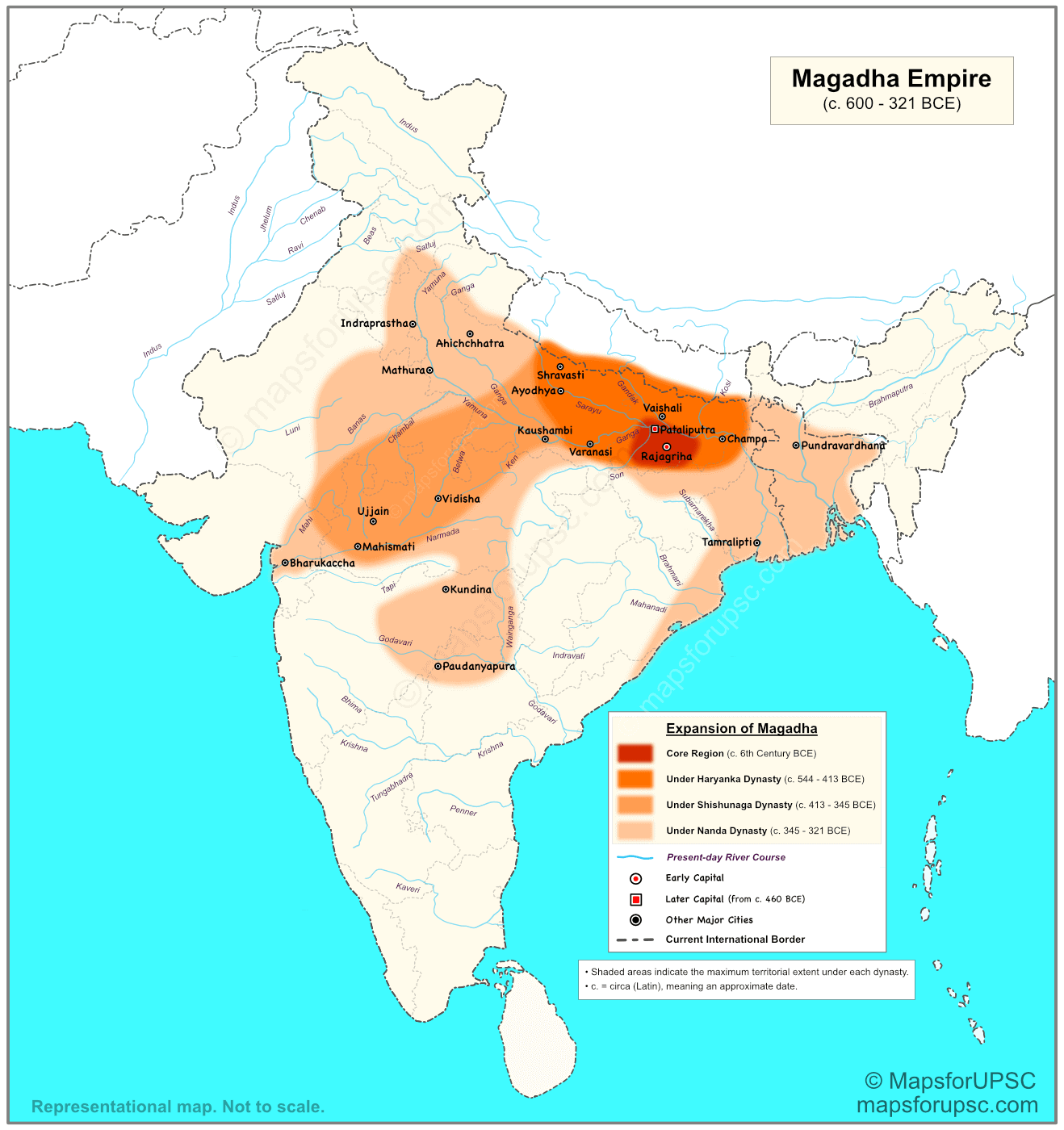
Important Notes:
- The exact dates of early Magadha rulers are subject to scholarly debate due to varying chronologies in different sources (Buddhist, Jain, and Puranic texts sometimes conflict).
- The boundary of Magadha’s territorial control sometimes fluctuated; the map shows maximum extent under each dynasty rather than continuous control.
- Dhana Nanda’s reign is more extensively documented in Greek sources (Megasthenes) than in Indian texts, providing unique historical perspective.
Geographic Location and Natural Advantages
Core Territory
Magadha’s core territory was located in what is now South Bihar, encompassing districts like Gaya, Nalanda, and Patna. The heartland centred around the Ganges River valley, which provided the civilization with critical advantages.
Strategic Advantages
| Advantage | Benefit |
|---|---|
| Iron Ore Deposits | Nearby Rajgir hills contained rich iron deposits, enabling superior weapons and tools manufacturing. |
| Fertile Gangetic Plain | Alluvial soils supported dense agricultural populations and generated substantial tax revenues. |
| River Systems | Ganges, Son, and Gandak rivers facilitated trade, communication, and defensive positioning. |
| Geographic Position | Central location in Indo-Gangetic valley enabled control of north-south and east-west trade routes. |
Capitals of Magadha Empire
Rajagriha (Rajgir)
- Time Period: 6th century BCE through Haryanka Dynasty
- Location: Present-day Rajgir in Nalanda district, Bihar
- Characteristics:
- Surrounded by five protective hills with ~40 km cyclopean wall fortification
- Natural fortress providing exceptional defensive advantages
- Connected to Buddhist history—Buddha frequently visited and taught here under the patronage of King Bimbisara
- Archaeological findings show sophisticated urban planning
Pataliputra (Patna)
- Time Period: From c. 460 BCE onwards
- Location: Confluence of Ganges and Son rivers, present-day Patna, Bihar
- Founder: Ajatashatru built the initial fort (c. 490 BCE); Udayin established it as primary capital (c. 460 BCE)
- Characteristics:
- Strategic central location superior for administering expanding empire
- Multiple rivers formed natural “water fort” (jaladurga)
- Controlled crucial riverine trade of Indo-Gangetic Plain
- Later became capital of Mauryan, Shunga, and other dynasties for ~1000 years
Please Note:
- ‘c.’ stands for circa, a Latin term meaning an approximate date.
- ‘r.’ stands for reigned and indicates the period of rule, not birth or death.
Magadha’s Territorial Expansion
Around c. 600 BCE, Magadha’s core region was confined to the central Gangetic plain in present-day Bihar. At this stage, it was one among the sixteen Mahajanapadas, without overarching political dominance.
Magadha’s rise to imperial power took place in three distinct phases, each under a different ruling dynasty.
Phase I: Haryanka Dynasty (c. 544–413 BCE)
During this period, Magadha began its initial expansion through conquest and diplomacy.
- Expansion towards the east and west
- Key regions brought under control: Anga, Kashi, and Vajji
Phase II: Shishunaga Dynasty (c. 413–345 BCE)
This phase marked political consolidation and the elimination of major rivals.
- Strengthening of authority in northern India
- Important territories annexed: Avanti and Vatsa
Phase III: Nanda Dynasty (c. 345–321 BCE)
Under the Nandas, Magadha reached its maximum territorial extent.
- Empire stretched from the Himalayan foothills to the Deccan plateau
- Absorption of almost all remaining independent Kshatriya kingdoms
Haryanka Dynasty (c. 544-413 BCE)
The Haryanka Dynasty established Magadha as a major power through military conquest and strategic alliances.
Bimbisara (r. 544-492 BCE)
Bimbisara was the founder of Haryanka Dynasty. He laid the political and economic foundations of early Magadha.
Key Achievements:
- Conquered Anga: Defeated the king of Anga and annexed it, gaining access to maritime trade routes and the strategic port city of Champa. This was Magadha’s first major territorial expansion.
- Strategic Marriage Alliance: Married the sister of Prasenjit (king of Kosala), receiving Kashi (Varanasi) as dowry—incorporating a religiously significant and commercially important city without military conflict.
- Administrative Innovation: Appointed officials called gramakas and mahamattas to govern conquered territories.
- Buddhist Patronage: Contemporary of Gautama Buddha; provided patronage and support to Buddhist sangha.
- Military Strength: Built effective military organization combining infantry, cavalry, and early war elephants.
Reign Significance: Transformed Magadha from regional power to major kingdom controlling eastern Gangetic valley.
Ajatashatru (r. 492-460 BCE)
Ajatashatru was the son and successor of Bimbisara. He consolidated and militarily strengthened Magadha, removing its main northern rivals.
Key Achievements:
- Vaishali Conquest: Fought extraordinary 16-year war against the powerful Vajjika League (federation led by Licchavis) to conquer the independent republic of Vaishali. This eliminated Magadha’s only serious northern rival (Vajji).
- Military Innovation: Employed advanced weapons including scythed chariots (Rathamusala), catapults (Mahashilakantaka), and war elephants.
- Recovered Kashi: After death of Prasenjit of Kosala, Ajatashatru recovered Kashi, which had temporarily reverted to Kosala control.
- Founded Pataliputra: Built strategic fort at confluence of Ganges and Son rivers during Vaishali campaign (later became capital).
- Religious Significance: Arranged the First Buddhist Council after Buddha’s death to compile Buddhist teachings; patron of Buddhism.
Reign Significance: Consolidated Magadha’s supremacy in northern India and pioneered military innovations that became standard for subsequent dynasties.
Udayin (r. 460-444 BCE)
Udayin, also known as Udayabhadra, was the son and successor of Ajatashatru.
Key Achievements:
- Capital Shift: Officially moved capital from Rajagriha to Pataliputra (c. 460 BCE).
- Strategic Positioning: Shifted capital to neutralize western threat from Palaka of Pradyota dynasty (Avanti).
- City Development: Fortified and expanded Pataliputra into major administrative and commercial center.
- Defeated Palaka: Engaged in successful military campaigns against Avanti forces, temporarily containing western rivals.
Reign Significance: Established Pataliputra as the capital, which would remain the primary seat of power for nearly 1000 years across multiple dynasties and Empires.
Later Haryanka Rulers (r. 444-413 BCE)
Successors included:
- Aniruddha and others whose reigns are less documented.
- Dynasty’s power gradually diminished as weaker rulers followed.
End of Haryanka Dynasty: Around 413 BCE, the Haryanka Dynasty was replaced by the Shishunaga Dynasty, either through internal conflict or external pressure (sources vary).
Shishunaga Dynasty (c. 413-345 BCE)
The Shishunaga dynasty marked a phase of territorial consolidation and western expansion, firmly establishing Magadha as the dominant power in northern India.
Shishunaga (r. 413-395 BCE)
Founder of Shishunaga Dynasty, Shishunaga rose to power after the decline of the Haryanka rulers and strengthened Magadha through decisive military action.
Key Achievements:
- Conquered Avanti: Defeated the Pradyota dynasty of Avanti and annexed its capital Ujjain. This was the most significant conquest, ending a long-standing rivalry between Magadha and Avanti.
- Unified northern India under single rule for the first time.
- Gave Magadha control of western trade routes (Dakshinapatha).
- Removed the only kingdom capable of challenging Magadha’s supremacy.
- Probable Annexations: Historical sources suggest he likely controlled or annexed Vatsa and Kosala, though evidence is less definitive than for Avanti.
- Territorial Consolidation: Extended Magadhan authority from Kuru country (north) to Godavari Valley (south).
- Capital Shift: Shishunaga temporarily shifted the capital of Magadha to Vaishali; it was later moved back to Pataliputra by his son and successor, Kalashoka.
Reign Significance: Transformed Magadha into the dominant political power of northern and central India.
Kalashoka (Kakavarna) (r. 395-362 BCE)
Kalashoka or Kakavarna was the son and successor of Shishunaga.
Key Achievements:
- Capital Consolidation: Further developed Pataliputra as primary capital.
- Administrative Stability: Maintained Shishunaga’s territorial acquisitions.
- Buddhist Patronage: Arranged the Second Buddhist Council to address doctrinal disputes within Buddhism.
Reign Significance: Provided stable rule and administrative consolidation after Shishunaga’s conquests.
Later Shishunaga Rulers (c. 362-345 BCE)
- Subsequent rulers are poorly documented and appear to have been weaker in authority.
- While Magadha’s territorial extent was largely retained, central control gradually weakened.
End of Shishunaga Dynasty: By c. 345 BCE, weakening Shishunaga authority led to the rise of the Nanda dynasty, which replaced them and began a new phase of large-scale expansion.
Nanda Dynasty (c. 345-321 BCE)
The Nanda Dynasty under Mahapadma Nanda greatly expanded Magadha’s power and created the largest territorial state in northern India at the time, achieving a level of political dominance unprecedented in earlier Indian history.
Mahapadma Nanda (r. 345-337 BCE)
- Founder of Nanda Dynasty
Historical Significance:
- First Non-Kshatriya Ruler: Unlike previous dynasties ruled by Kshatriyas (warrior caste), Mahapadma Nanda was of humble origins—a revolutionary break from tradition
- Title: “Sarva-Kshatriyantaka” (Destroyer of All Kshatriyas) and “Ekarat” (Sole Sovereign)
Key Achievements:
- Military Conquests: Systematically destroyed all remaining independent Kshatriya kingdoms, annexing:
- Northern Regions: Kuru (Indraprastha), Panchala (Kampilya, Ahichatra)
- Central Regions: Chedi (Suktimati), Vatsa (possibly), Kosala (possibly)
- Eastern Regions: Kalinga (Odisha)
- Western Regions: Malwa region already controlled through Shishunaga inheritance
- Southern Region: Asmaka (Paudanyapura)—the only southern Mahajanapada, extending empire into Deccan
Administrative Organization:
- Centralized imperial administration
- Sophisticated tax collection systems
- Standardized measures and weights across empire
Territorial Extent: The empire stretched from:
- North: Himalayas foothills
- South: Deccan plateau (Godavari valley via Asmaka)
- East: Kalinga (Odisha) and Bengal
- West: Punjab and possibly Indus region (disputed)
Historical Impact: Created the first truly continental empire before the Mauryas, demonstrating that unified rule across diverse territories was possible—a blueprint Chandragupta Maurya would later perfect.
Reign Significance: Transformed Magadha from a major regional power into the most dominant political authority in northern India.
Important Chronological Note:
Between the reigns of Mahapadma Nanda (r. 345–337 BCE) and Dhana Nanda (r. 329–321 BCE), that is, c. 337–329 BCE, Magadha appears to have been ruled by short-lived and largely undocumented successors. Ancient sources provide limited detail on this phase, which seems to have been marked more by maintenance of the empire than by major expansion.
Dhana Nanda (r. 329-321 BCE)
- Son of Mahapadma Nanda and the final ruler of Nanda Dynasty.
- Known as “Agrammes” or “Xandrames” in Greek sources.
- Extremely wealthy; possessed vast treasury built by his father.
- Allegedly unpopular due to harsh taxation and authoritarian rule.
- First Indian ruler widely documented in Greek accounts by Megasthenes and others.
End of Dynasty:
- Defeated by Chandragupta Maurya (with strategic guidance from Chanakya/Kautilya) around 321 BCE.
- Marked end of pre-Mauryan era and beginning of Mauryan Empire, which would eventually control even greater territory under Ashoka.
Reign Significance: Despite his unpopularity, Dhana Nanda maintained the vast empire built by his father until external conquest ended Nanda rule. The transition to Mauryan rule represented continuity rather than collapse—the administrative and military systems remained largely intact.
Key Rulers Summary Table
| Dynasty | Ruler | Reign (BCE) | Key Achievement |
|---|---|---|---|
| Haryanka | Bimbisara | 544-492 | Founded dynasty; conquered Anga; married into Kosala |
| Ajatashatru | 492-460 | 16-year Vaishali war; recovered Kashi; founded Pataliputra fort | |
| Udayin | 460-444 | Shifted capital to Pataliputra (c. 460 BCE) | |
| Later rulers | 444-413 | Dynasty decline | |
| Shishunaga | Shishunaga | 413-395 | Conquered Avanti/Ujjain; ended 100-year rivalry |
| Kalashoka | 395-362 | Administrative consolidation; Second Buddhist Council | |
| Later rulers | 362-345 | Dynasty decline | |
| Nanda | Mahapadma Nanda | 345-337 | Major territorial expansion; unified most of northern India |
| Other Rulers | 337-329 | Weak rulers, but maintained empire. | |
| Dhana Nanda | 329-321 | Maintained empire; overthrown by Chandragupta Maurya |
Why Magadha Rose to Dominance
Several factors explain Magadha’s unprecedented rise to supremacy:
1. Geographic Advantages
- Iron Ore: Rajgir hills provided raw materials for weapons manufacturing, giving military superiority
- Fertile Gangetic Plain: Agricultural surplus supported growing population and military
- River Systems: Ganges, Son, and Gandak enabled trade and military logistics
- Central Position: Strategic location allowed control of trade routes in all directions
2. Administrative Innovation
- Centralized Authority: Moved from feudalistic systems to centralized imperial rule
- Bureaucratic Organization: Appointed officials (gramakas, mahamattas) to govern territories
- Tax Systems: Sophisticated revenue collection mechanisms funded military expansion
3. Military Innovation
- War Elephants: First large-scale deployment by Ajatashatru revolutionized warfare
- Advanced Weapons: Catapults, scythed chariots, and coordinated infantry-cavalry tactics
- Standing Army: Maintained permanent, trained military force unlike rival kingdoms
4. Succession of Capable Rulers
- Bimbisara: Visionary founder establishing expansionist policy
- Ajatashatru: Military genius who eliminated powerful rivals
- Udayin: Strategic administrator who recognized capital’s importance
- Shishunaga: Conquered last major rival (Avanti)
- Mahapadma Nanda: Comprehensive conqueror who unified subcontinent
5. Lack of United Opposition
- No coalition of Mahajanapadas united against Magadha
- Individual kingdoms conquered piecemeal rather than facing unified resistance
- Shishunaga’s conquest of Avanti removed only comparable power
Religious and Cultural Significance
Buddhism and Jainism
- Buddhist Patronage: Bimbisara and Ajatashatru were major Buddhist patrons; Magadha was center of early Buddhism
- Buddhist Councils: First Buddhist Council held under Ajatashatru; Second under Kalashoka
- Bodh Gaya: Within Magadha; site of Buddha’s enlightenment
- Nalanda: Later became world’s foremost Buddhist university in Magadha region
Urban Development
- Pataliputra: Became world’s largest city of its era under Nanda Dynasty
- Rajagriha: Major pilgrimage and learning center
- Urban Planning: Advanced city layouts with grid-pattern streets, drainage systems, and public buildings
Decline of Magadha and Rise of Mauryans
Final Years of Nanda Dynasty
- Unpopular Rule: Dhana Nanda’s harsh taxation and authoritarian governance created discontent
- Vulnerability: Despite military strength, discontent provided opening for rebellion
Conquest by Chandragupta Maurya (321 BCE)
- Strategic Overthrow: Chandragupta Maurya, guided by political strategist Chanakya (Kautilya), overthrew Dhana Nanda
- Continuity: Rather than collapse, the Nanda administrative and military systems passed intact to Mauryan rule
- Expansion: Chandragupta used inherited Nanda infrastructure to expand empire even further
- Peak Under Ashoka: Mauryan empire reached zenith under Ashoka the Great, conquering Kalinga and later renouncing violence for Buddhism
