
The 16 Mahajanapadas (“Maha“ = great, “Janapada“ = foothold of the people/tribe) were the dominant territorial states that emerged in ancient India during the 6th century BCE. This period marks the second urbanization phase in Indian history, following the Indus Valley Civilization.
- Around 600 BCE, these large political units emerged from smaller tribal settlements (Janapadas) through agricultural expansion, iron tool usage, and growing trade networks.
- According to the Buddhist text Anguttara Nikaya, there were 16 principal Mahajanapadas, spread across the Indo-Gangetic plains, extending to present-day Afghanistan, Pakistan, and central India.
- Formally, this Mahajanapada period lasted from approximately 600 BCE to 322 BCE, ending with the rise of the Mauryan Empire under Chandragupta Maurya.
- The Mahajanapada period was deeply influenced by the rise of new philosophical and religious movements such as Jainism and Buddhism.
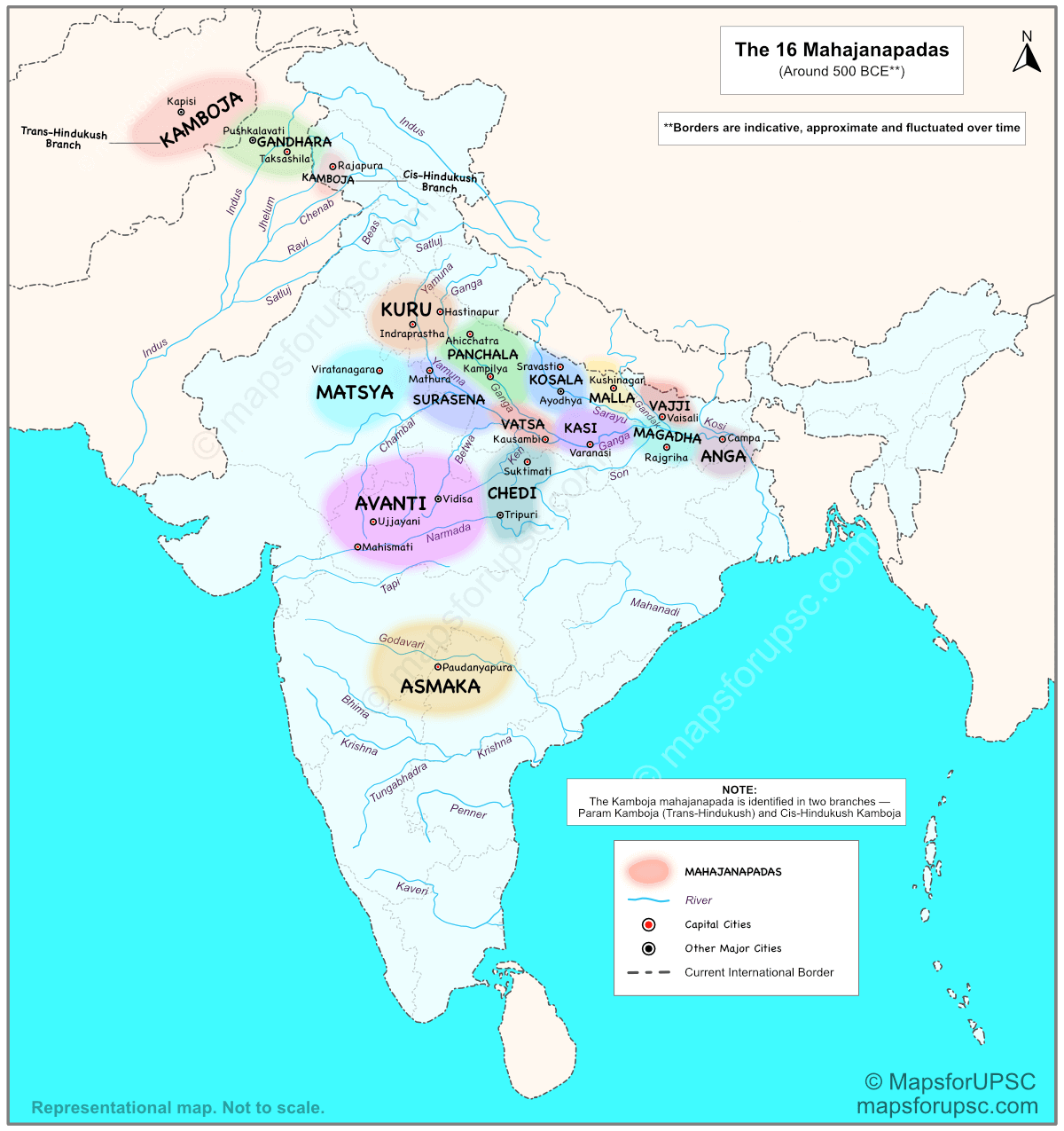

16 Mahajanapadas Names and Key Details
The following table lists the 16 Mahajanapadas along with their capitals, approximate present-day locations, and the major rivers flowing through/near the regions:
Please Note:
- Many ancient place names appear in different forms across texts and inscriptions. For example, the capital of Asmaka (Assaka) is variously recorded as Potana, Potali, Podana, or Paudanyapura. Similarly, Taxila is also known as Takshashila, and several other capitals have multiple accepted name variations.
- Some Mahajanapadas had two capitals, such as Panchala (with separate capitals for North and South Panchala). In a few cases, the capital changed over time—for instance, Magadha shifted its capital from Rajagriha to Pataliputra in a later period.
| Mahajanapada | Capital | Current Location | River/Water Source |
| Anga | Champa | Munger & Bhagalpur region (Bihar) | Champa, Ganga, Kosi |
| Magadha | Rajagriha, Pataliputra | South Bihar (Gaya, Patna) | Ganga, Son |
| Vajji (Vrijji) | Vaishali | North Bihar (Vaishali) | Gandak |
| Malla | Kushinagar, Pava | North Eastern UP (Gorakhpur region) | Gandak |
| Kashi | Varanasi | Eastern UP (Varanasi) | Ganga, Varuna, Assi, |
| Kosala | Shravasti | North-Central UP (Awadh Region) | Sarayu (Ghaghara) |
| Vatsa | Kaushambi | Near Prayagraj, UP | Ganga, Yamuna |
| Kuru | Indraprastha, Hastinapur | Delhi, Haryana, Western UP | Yamuna, Ganga |
| Panchala | Ahichchhatra, Kampilya | Western & Central UP | Ganga, Yamuna |
| Matsya | Viratanagara | Jaipur region, Rajasthan | Chambal |
| Shurasena | Mathura | Mathura (Uttar Pradesh) | Yamuna |
| Chedi | Shuktimati | Bundelkhand region (UP, MP) | Ken |
| Avanti | Ujjayini, Mahishmati | Malwa Region (Madhya Pradesh) | Shipra, Narmada |
| Gandhara | Taksashila (Taxila) | Rawalpindi, Peshawar (Pakistan) | Indus, Kabul |
| Kamboja | Rajapura | NE Afghanistan, NW Pakistan, SW Kashmir | Kunar |
| Assaka (Ashmaka) | Potali (Potana or Paudanyapura) | Godavari Basin (Telangana, Maharashtra) | Godavari |
Individual Mahajanapadas: Key Facts
Note: The table below presents key facts about each Mahajanapada apart from the capitals, locations, and rivers listed in the table above.
| Mahajanapada | Key Facts |
|---|---|
| Anga | • Government Type: Monarchy • It was a major commercial hub and a centre for trade with Southeast Asia (Suvarnabhumi). • Its capital, Champa, located on the confluence of Ganga and Champa rivers, was a major river port. • Later annexed by Bimbisara, marking the first step in Magadha’s expansion. |
| Magadha | • Government Type: Monarchy • Rose to prominence and eventually conquered most other Mahajanapadas under the Magadha Empire. • Iron ore deposits in Jharkhand provided superior weaponry. • Confluence of Ganga and Son rivers at Pataliputra made it a major trade hub. • Later became the seat of the Mauryan Empire. • Ruled by powerful dynasties like the Haryankas, Shishunagas, and Nandas. • Notable Rulers: – Bimbisara: Founder of Haryanka Dynasty; contemporary of Buddha. – Ajatashatru: Expanded territory; arranged 1st Buddhist Council. – Udayin: Shifted capital to Pataliputra from Rajagriha. – Shishunaga: Defeated Avanti; founded Shishunaga Dynasty. – Mahapadma Nanda: Called “Ekarat” or Empire-builder; first non-Kshatriya ruler. • The centre of activity for both Gautama Buddha and Mahavira. • Budha attained enlightenment (Nirvana) at Bodh Gaya in Magadha. |
| Vajji (Vrijji) | • Important republican state; major trading center; renowned for democratic governance. • Ruled by a confederacy of 8 clans—Lichchavis (capital Vaishali), Videhans (capital Mithila), Jnatrikas (Mahavira belonged to this clan), and others. • Lord Mahavira (24th Tirthankara of Jainism) was born at Kundagrama (near Vaishali). • The famous courtesan Amrapali lived here and later became a disciple of Buddha. |
| Malla | • It was a republican state, but unlike Vajji — which was a confederacy of 8 clans — the Mallas were organised as a single-clan republic. • This region includes the sites of the Mahaparinirvana (death) of both Lord Buddha (at Kushinara) and Lord Mahavira (at Pava). |
| Kashi | • Government Type: Monarchy • Before Buddha’s time and before the rise of Magadha, Kashi was the most powerful state. It was a great centre of learning and Vedic culture. • Renowned for its fine cotton and silk fabrics (Kashi vastra). • Eventually captured by Kosala (during Buddha’s lifetime) and later annexed by Magadha. |
| Kosala | • Government Type: Monarchy • Most powerful Mahajanapada during Buddha’s time. • King Prasenajit was Buddha’s contemporary and patron. • Included the tribal republic of Shakyas with capital at Kapilavastu (Buddha’s clan), where Buddha was born at Lumbini. • Lord Buddha delivered the maximum number of his sermons at its capital, Shravasti. • Included the holy city of Ayodhya, located on the banks of the Sarayu (Ghaghara) river. |
| Vatsa | • Government Type: Monarchy • Capital Kaushambi was a thriving trade centre connecting North and South India. • A stronghold of Brahmanism that later embraced Buddhism; Udayana made Buddhism the state religion. • King Udayana featured prominently in three Sanskrit plays by Bhasa and Harsha. |
| Kuru | • The center of the Later Vedic civilization; the Mahabharata war was fought here. • Gradually shifted from a monarchy to a republic structure. • The region corresponds to modern-day Haryana/Delhi, an agricultural heartland. |
| Panchala | • Divided into North Panchala (Capital: Ahichchatra) and South Panchala (Capital: Kampilya) by the Ganges River. • Developed fortified cities; important for its craft production and urban centers. • Initially a monarchy, it later transitioned into a republican corporation (Sangha). |
| Matsya | • Government Type: Monarchy • Situated in the region encompassing modern-day districts of Jaipur, Alwar, and Bharatpur in Rajasthan. • It had little political significance in the Buddha’s time and was eventually absorbed by Magadha. |
| Shurasena | • Government Type: Monarchy • The capital, Mathura, is associated with the birth and early life of Lord Krishna. • Located at the junction of two major trade routes (Uttarapath and Dakshinapatha). • King Avantipura was Buddha’s disciple. • Mathura later became a major Buddhist centre—visited by Greek ambassador Megasthenes. |
| Chedi | • Government Type: Monarchy • One of the most ancient tribes mentioned in the Rig Veda, located in the Bundelkhand region. |
| Avanti | • Government Type: Monarchy • Divided into two parts by Vindhya Range: North Avanti (Capital – Ujjayini) and South Avanti (Capital – Mahishmati) • A major rival to Magadha due to its own large iron ore deposits. Eventually defeated by Shishunaga of Magadha. • King Pradyota was a powerful ruler and a contemporary of Buddha and Bimbisara. • An important centre of Buddhism; Mahakaccana (a disciple of Buddha) spread the religion here. • Ujjain was a nodal point for trade and later became a prime meridian for Indian astronomers. |
| Gandhara | • Government Type: Monarchy • Taxila was a world-renowned university and center of learning for arts, medicine, and war. • Associated with Panini (Grammarian) and Chanakya (Kautilya). • King Pukkusati exchanged gifts with King Bimbisara of Magadha and later set out on foot to meet the Buddha. • Mentioned in Behistun Inscription of Persian Emperor Darius I as being conquered by Persians in the 2nd half of 6th century BCE. • Important for Kharoshti script and Persian cultural influence. • Later became a major hub of Gandhara Buddhist art (Greco-Buddhist influence). |
| Kamboja | • Government Type: Republican • Situated on Uttarapatha (northern trade route). • This Mahajanapada is identified in two branches – Param Kamboja (Trans-Hindukush) and Cis-Hindukush Kamboja. • Controlled the Hindukush passes, acting as a gateway to India. • Renowned for excellent breed of horses and skilled horsemen. • Later came under Persian control. • While initially a monarchy, Kautilya’s Arthashastra refers to them as a republic of warriors. |
| Assaka (Ashmaka) | • Government Type: Monarchy • Only Mahajanapada south of Vindhya Mountains. • Located on Dakshinapatha (southern trade route) and includes the Pratisthan or Paithan region. |
Government Types of the Mahajanapadas
1. Monarchies (Hereditary Kingdoms)
- Centralized states ruled by hereditary kings, supported by a Mantri-Parishad (council of ministers).
- Decision-making rested largely with the king, backed by administrative officials and military commanders.
- Examples of Monarchical Mahajanapadas: Kosala, Magadha, Kashi, Anga, and Avanti
2. Gana-Sanghas (Republics)
- Confederations of clans governed collectively through Sanghas and Santhagaras (assembly halls).
- Authority was decentralized, resting in councils of clan chiefs rather than a single ruler.
- Decisions were often debated and voted upon.
- Examples of Republican Mahajanapadas: Vajji, Malla, and Kamboja
Significance of the Mahajanapadas
- The Mahajanapadas marked the shift from tribal societies to organised political states.
- Urban centres, trade networks, taxation systems, and early administration took shape during this era.
- Both monarchies and republics emerged, showing diverse political experimentation.
- Magadha’s rise and the creation of the Mauryan Empire were direct outcomes of the strengths built during this period.
- Buddhism and Jainism flourished across these states, influencing India’s cultural and spiritual development.
- Overall, the Mahajanapadas laid the groundwork for classical Indian civilisation.
